A drag strip
timing system,
in your pocket.
Measure 0–60, 60–130 and the quarter mile. See your splits, understand the conditions, and compare your best runs.
Available for iPhone and Android. Start with your phone — no board required.
SPEEDY
73 °F
·
774 ft
·
DA2043 ft
132
MPH
1543ft
- 0–60
- 4.00s
- 60–130
- 8.70s
- 0–130
- 12.70s
- 1/4 mile
- 11.92s
View Details
Test
My times
Leaderboard
Settings
The Speedy board
Hardware · first batch sold outGive your runs a dedicated GPS receiver. The Speedy Board pairs with the app over Bluetooth, combining its own GNSS antenna and motion sensor in a compact, USB-C rechargeable case. Your phone stays the screen; the board provides the measurements.
Be ready for the next batch.
The first batch is sold out. Interested in v2? Email us to hear when it becomes available.
Email me about v2 → Opens your email app. Send the message to register your interest.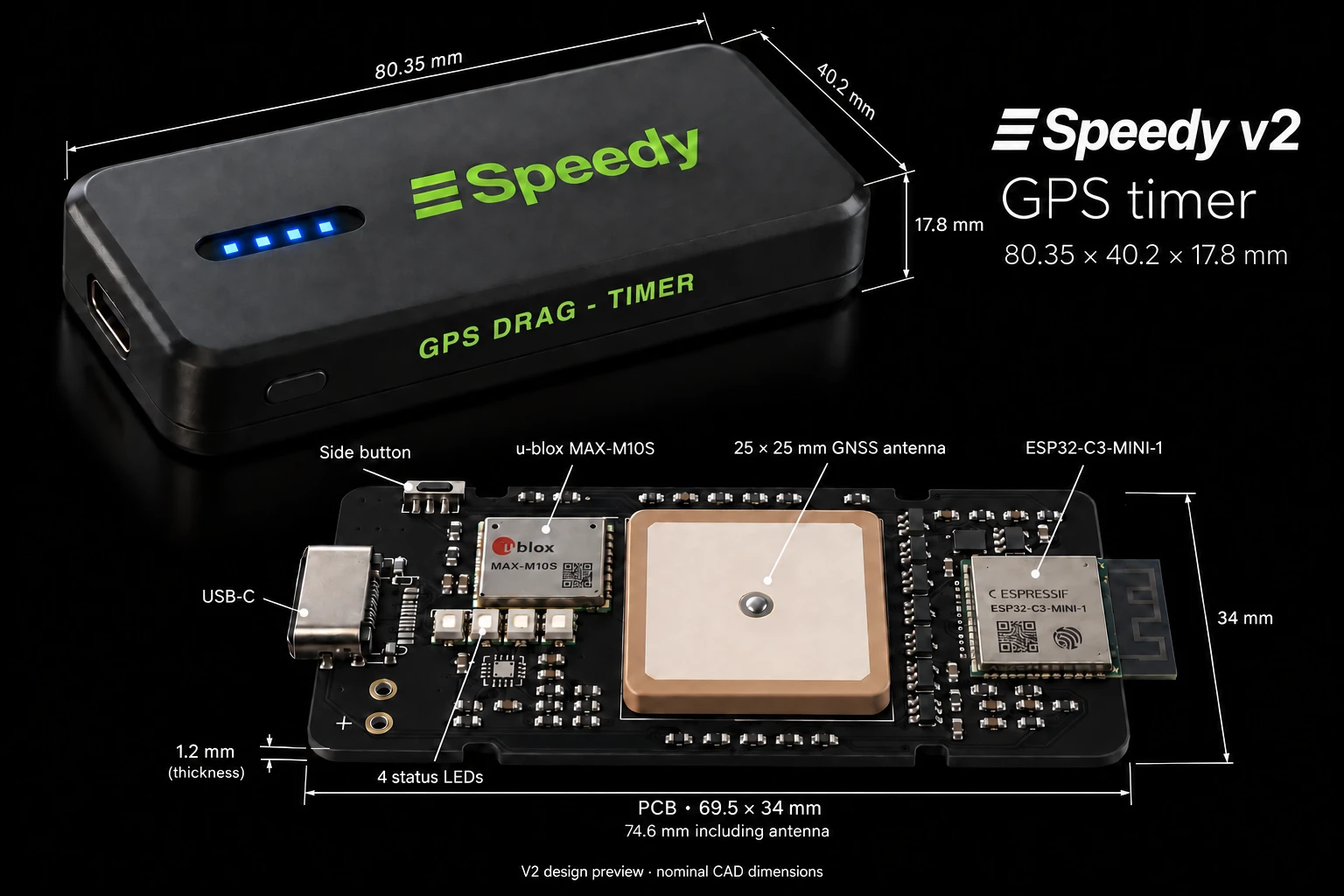
V2 design preview · nominal CAD dimensionsView full-size render ↗
Dedicated GNSS
u‑blox MAX‑M10S with its own 25 × 25 mm patch antenna, dedicated to measuring your run.
Launch detection
A dedicated six-axis motion sensor provides acceleration and rotation data to the app.
Lives with the app
Bluetooth LE to your phone, firmware updates through the app, USB‑C charging, and a four-LED gauge: charge level, a sweep while it hunts satellites, solid on fix.
Pocket sized
The v2 design fits a 69.5 × 34 mm PCB into an 80.35 × 40.2 × 17.8 mm case with magnets in the base. Nominal CAD dimensions.
Start with your phone. Add a dedicated sensor.
Use the app on its own, or connect a Speedy Board. Your run history and leaderboard stay in the same app.
| Your setup | Phone alone | With Speedy Board |
|---|---|---|
| GPS source | Your phone’s location sensor | Dedicated u-blox GNSS receiver and 25 × 25 mm antenna |
| Motion sensing | Your phone’s motion sensors | The board’s six-axis motion sensor |
| Setup | Open Speedy on your phone | Charge the board and connect through the app over Bluetooth |
| Results | Splits, run history and leaderboards in Speedy | The same app, using measurements from the board |
The timing slip
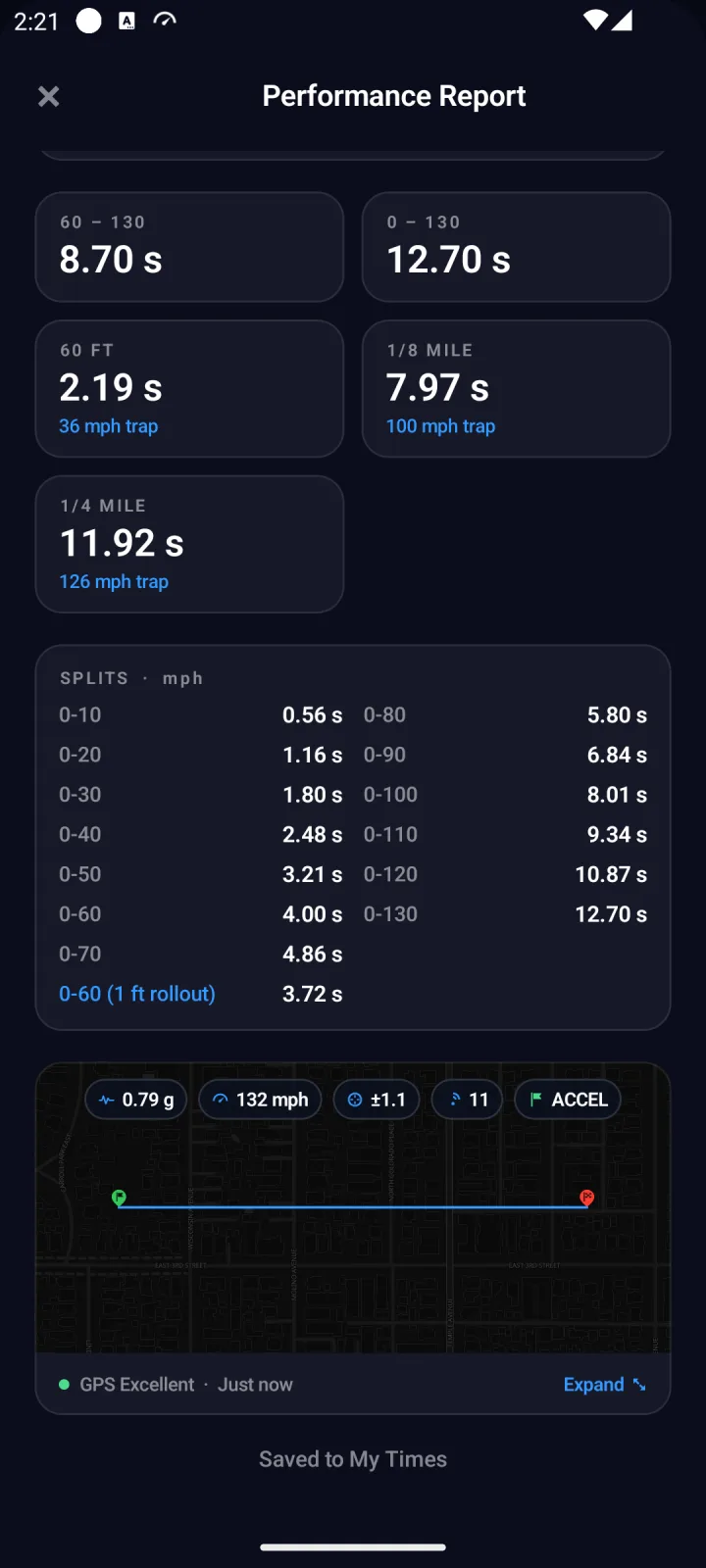
Explore an example timing report
Speed · mph
- 0–60
- 4.00s
- 60–130
- 8.70s
- 0–130
- 12.70s
Speed · km/h
- 0–100
- 4.18s
- 100–200
- 7.47s
- 0–200
- 11.65s
Distance
- 60 ft
- 2.19s @ 36 mph
- 1/8 mile
- 7.97s @ 100 mph
- 1/4 mile
- 11.92s @ 126 mph
Illustrative demo data — 132 mph top speed, 0.79 g peak, GPS ±1.1 mph on 11 satellites, 73 °F at 774 ft with a 2,043 ft density altitude, +1.2% grade. The 1‑ft rollout brings this pass's 0–60 to 3.72 s, and every board keeps splits at each 10 mph or km/h.
How a pass gets timed
GPS and the accelerometer, fused
Speed comes from GPS; the launch instant comes from the accelerometer. The report shows GPS accuracy, satellite count and launch confidence, so you can review the conditions behind each result.
Density altitude, computed per run
Temperature and pressure are looked up for where you are, and the report carries elevation, slope and density altitude — the difference between a brag and a baseline.
The whole curve, kept
Every run is saved on your phone with its splits, speed and g traces, and the ground track drawn on a map. Nothing to export, nothing expiring.
Put it on the board
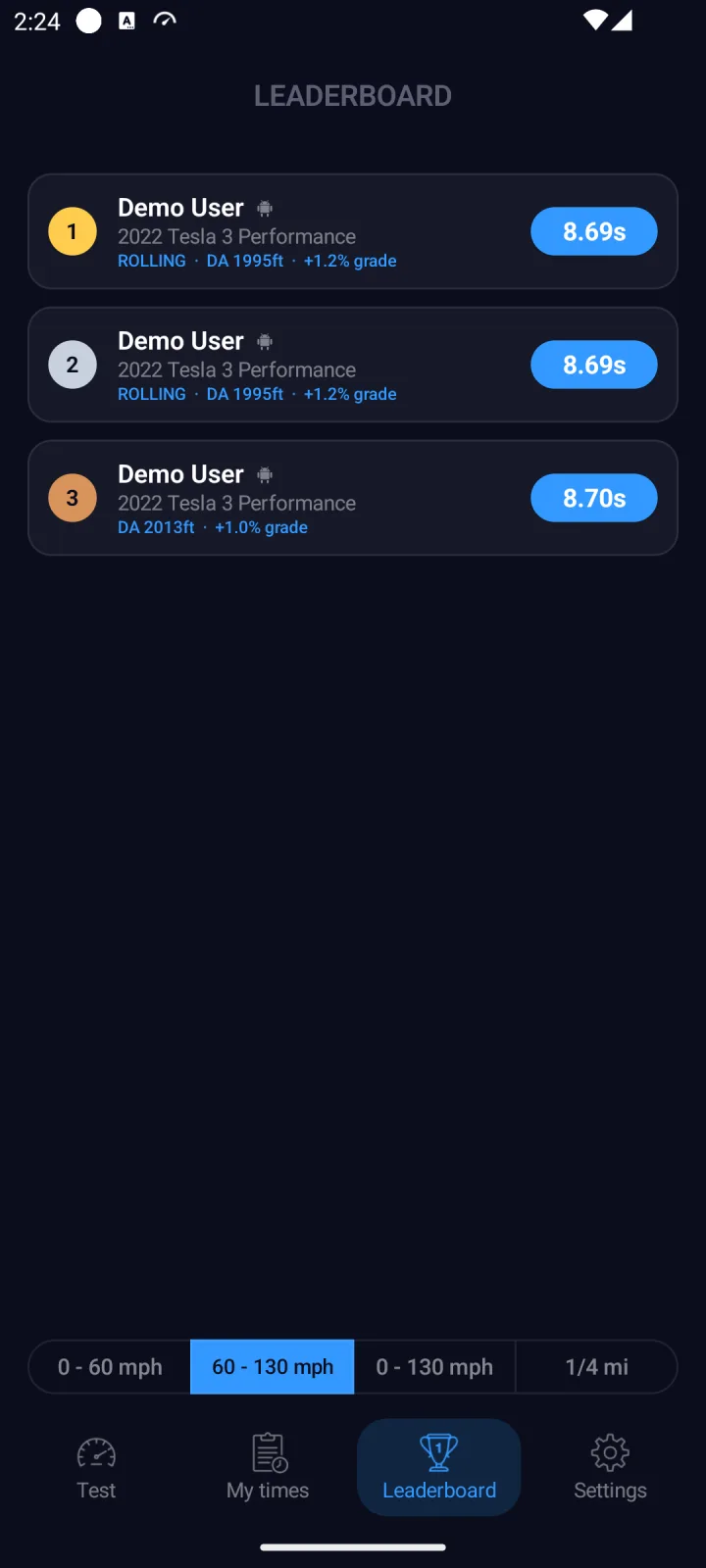
Compare your best runs with other drivers. Each entry includes the car, trap speed and conditions, with times taken directly from the recorded run.
Phone and Speedy Board runs share the same leaderboards, with an icon showing the measurement source.
Your route stays home
Publishing sends the numbers, never the map. The GPS track of your run is stored only on your phone and is stripped from every leaderboard entry before it leaves the device.
Before your first run.
A few things to know about the app and the next Speedy Board.
Something else on your mind? Email us →
Do I need a Speedy Board to use the app?
No. Speedy can measure runs using your phone’s GPS and motion sensors. The board is an optional, dedicated measurement source that connects over Bluetooth.
Does Speedy work on iPhone and Android?
Yes. Speedy is available on the App Store and Google Play. Both apps support connecting to a Speedy Board.
Does the board replace my phone?
The board supplies GPS and motion measurements. You still use the Speedy app on your phone to view and manage your runs.
Can I buy the v2 board now?
The first test batch is sold out, and v2 is shown here as a design preview. Email your interest in v2 to hear when the next batch becomes available.
What about pricing, battery life and shipping?
Final v2 pricing, measured battery life, box contents and shipping details are not announced on this page yet. Email us about the next batch for availability and details.
Does publishing a run share my route?
No. Leaderboard entries include your results and vehicle details. Your GPS route stays on your phone and is not included in the published entry.
Your next run starts here.
Get Speedy for your phone, or email your interest in the next board.